Interview: Slovenian Entrepreneurs Cover Istria
Challenge
Finance newspaper interview about cross border expansion.
Result
Regional expansion strategy and the technology behind it.
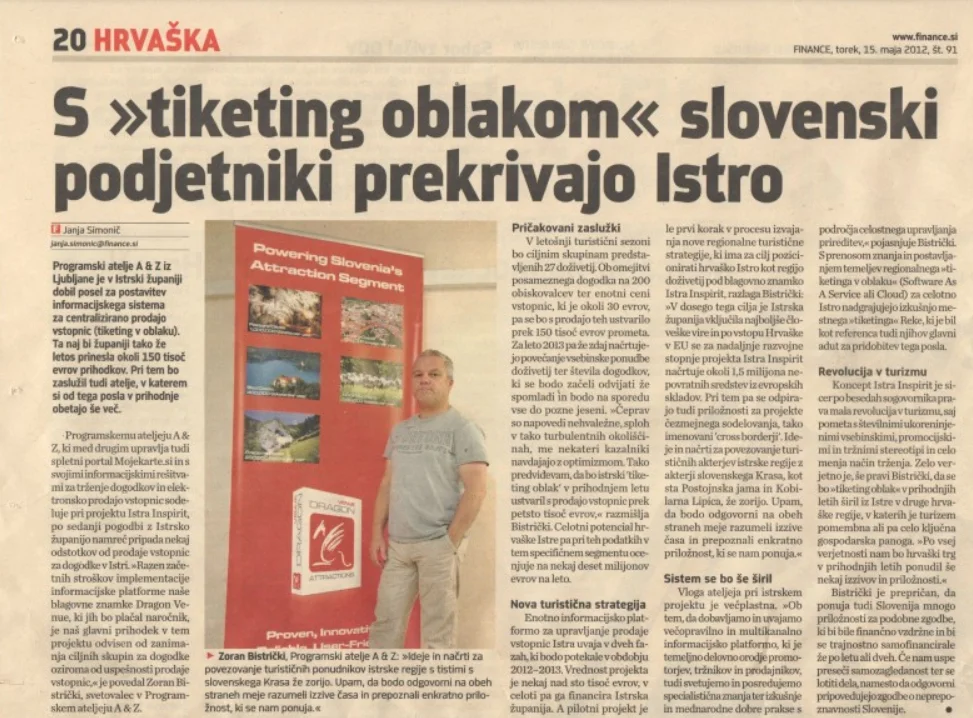
Interview: Slovenian entrepreneurs cover Istria with a ticketing cloud
Slovenian entrepreneurs cover Istria with a ticketing cloud
On Tuesday, May 15, 2012, the Finance newspaper published an article by journalist Janja Simonic titled Slovenian entrepreneurs cover Istria with a ticketing cloud. The article covers the involvement of Programski atelje A&Z d.o.o. in the Istra Inspirit project, led by the Istrian Development Tourism Agency (IRTA) under the auspices of the Istrian County.
The County of Istria decided to comprehensively and systematically organize all activities involving ticket sales and to raise the level of service to match the expectations, wishes and needs of modern target audiences. They quickly realized that such a goal is most easily achieved by introducing a unified, overarching platform for managing and promoting offerings as well as marketing and selling tickets. The integrated Mojekarte platform, developed by the Slovenian company Programski atelje A&Z d.o.o., was selected as the most suitable solution. We spoke about this project and the company's future plans with Zoran Bistric, management advisor and expert in modern electronic business.
Finance: How did you get the contract on the Istra Inspirit project?
To answer that, I have to go back a few years. In 2004, the City of Rijeka selected Programski atelje A&Z as its partner through an international tender for the e-Munis project. Through this multi-year project, the city was introducing advanced electronic public services for its citizens, and one such practical service identified by the city administration was a unified municipal ticket sales system. We built it on our proprietary integrated information platform Mojekarte. The Rijeka municipal ticketing system, if I use that somewhat archaic term which no longer captures all the dimensions of modern digital platforms, remains to this day the only system of its scale in Croatia and the broader region. It serves as an example of an effective solution that takes a modern, holistic approach to event promotion, marketing and ticket sales. The e-Munis project received considerable attention from Croatian media, and through their coverage our company presented itself as a potential partner for Croatian municipalities facing similar challenges. When the Istrian County was looking for a competent partner to provide comprehensive information support for marketing and selling experiences under the Istra Inspirit brand, this did not go unnoticed, and the reference from Rijeka was the decisive factor that tipped the client's choice in our favor.
Finance: How much is this project worth and where do the funds come from? You also mentioned European money, how much will there be?
The value of the initial project, which started this year and will be completed in June 2013, is just over 100,000 EUR, fully financed by the Istrian County. But the pilot project is only the first step in implementing a new regional tourism strategy aimed at positioning Croatian Istria on the world tourism map as a region of experiences. The Istrian County has engaged the best human resources for this goal, led and coordinated by Dr. Manuela Hrvatin. After Croatia's full EU membership, approximately 1.5 million in non-refundable EU funds are planned for subsequent phases of the Istra Inspirit project. Additionally, opportunities are opening up for cross-border cooperation projects. Ideas and plans for connecting tourism operators in the Istrian region with operators on the Slovenian Karst (for example Postojna Cave, Lipica Stud Farm and others) are already maturing, and I hope that the responsible parties on both sides of the border will understand the challenges of the time and recognize this unique opportunity. I am optimistic about that.
Finance: Where and how did you identify your business opportunity? What does your company specifically expect from this deal?
The Istra Inspirit concept is a small revolution in tourism, sweeping away many entrenched content, promotional and marketing stereotypes. In my assessment, this concept is even changing the paradigm of tourism product marketing. Our role in this project is multi-layered. Beyond delivering and implementing the multi-purpose, multi-channel Mojekarte information platform, which is the fundamental working tool for promoters, marketers and sales teams, we simultaneously provide consulting, specialist knowledge, experience and international best practices in the field of holistic event management. By transferring knowledge into the Istrian environment and establishing the foundations of regional ticketing in the cloud (Software As A Service) for all of Istria, we are building upon the experience of Rijeka's municipal ticketing. It is very likely that this ticketing cloud will expand from Istria to other Croatian regions where tourism is a significant or even dominant economic sector in the coming years. The Croatian market will most likely offer us additional challenges and opportunities to demonstrate the quality and utility of our knowledge and the effectiveness of our Mojekarte platform.
Finance: How much will you earn from this deal (what revenue from the solution do you expect), at least an estimate or expectation?
We started changing and adapting our business models over ten years ago, and for years now we have been selling services rather than software or software solutions. Besides the initial implementation costs of the Mojekarte platform, which the client will pay, our main revenue in the Istra Inspirit project depends on the interest of target audiences, or in other words, on the success of ticket sales for events. The initial project in this tourist season will present 27 experiences at nine historical locations to target audiences. With each event limited to 200 visitors for exclusivity and to ensure an appropriate level of quality, and a unified ticket price of around 30 EUR, ticket sales will generate approximately 150,000 EUR in turnover. Under the current contract, a percentage of that turnover goes to our company. For 2013, an expansion of the experience offerings and the number of events is already planned, starting in the spring months and continuing through late autumn. Although forecasts are unreliable, especially in such turbulent times, certain indicators make me optimistic. I project that the Istrian ticketing cloud will generate over 500,000 EUR in ticket sales turnover in 2013, while the total potential of Croatian Istria in this specific segment, based on current data, I estimate at several tens of millions of EUR per year. The business interest is obvious.
Finance: What are your business goals for 2012 and 2013?
Regarding the Croatian market, this year we will focus primarily on the project in Istria, upgrading and modernizing the Rijeka system, and implementing automated spectator access control at the football stadium in Pula. 2013 will certainly be most marked by the second phase of the Istra Inspirit project and expanding the circle of Mojekarte platform users to cultural, museum, sports and similar activities. We will also be looking for an opportunity for a smaller cross-border pilot project through which we could test various business models and gain the necessary experience for larger projects in the coming years. Of course, we will continue developing our software with undiminished intensity and seek opportunities to expand into new markets. We plan to be present with the Mojekarte platform in at least ten markets by 2015.
Finance: What about plans for the near future: in general, regarding markets, new projects, business results, possible hiring?
We certainly want to continue co-shaping development trends and staying at the top of the global electronic ticketing industry. To achieve this, we will maintain a high pace of development. Already in autumn 2012, we will offer users in Slovenia innovative promotional, marketing and sales tools that will enable direct and personal e-communication with each individual visitor, as well as maintaining and nurturing e-contacts, all with the goal of greater visitor satisfaction and better sales results. We will also continue looking for opportunities to repeat the deal from a few years ago, when we sold the intellectual property rights for Mojekarte to the largest private IT company in the United Kingdom, bundled with an appropriate package of services. Since the British company needs quality consulting and continuous expert support, the collaboration continues and its financial scope is growing. There is something else important about this deal. Along with an internationally significant reference, the UK events market gives us the opportunity to absorb the most modern organizational, marketing and business knowledge in the event management industry. We transform this knowledge through the development process into concrete user functions and solutions, which makes each new software version even more competitive on global markets. Some of these ideas and professional insights are also implemented through the Mojekarte.si web portal, which is the most complete and highest-quality aggregation of event, happening and experience offerings on the Slovenian market. In line with the challenges and development dynamics of our main product Mojekarte and our successes in conquering new markets, we will of course strengthen our human resources and maintain the competences of our development team and our user support and consulting team.
Finance: How is your business going in Slovenia otherwise?
Considering all circumstances, we can be satisfied with 2011. Among the developments on the domestic market, I think it is worth highlighting the successful entry of the integrated Mojekarte platform into the tourism industry. The utility, effectiveness and flexibility of this digital working tool, the international references and the team's competences convinced the management of Postojna Cave, Ljubljana Castle, Lipica Stud Farm and the Park of Military History in Pivka to adopt the platform. Together with Bled Castle and Park Skocjan Caves, all the key players that shape the Slovenian tourist attractions market are now among Mojekarte users. This opens up challenges and opportunities for connecting these tourism entities and creating extra added value that arises from selling more complex tourism products, particularly bundled packages. The Mojekarte platform of course remains open to everyone who recognizes the opportunity to develop new products and services in collaboration with other stakeholders, open new promotional, marketing and sales channels (especially digital ones), and make the most of modern information and telecommunications technologies, particularly the internet and mobile telephony.
Finance: What did you mean by the following, please explain: From all this we can conclude that the profession and politics in Istria see quite far ahead, and they understand today's challenges in a way that is substantially closer to the wishes, expectations and needs of the modern tourist.
The profession and politics in the Istrian County realized that things in tourism have been changing extremely quickly in recent years and that previous concepts and principles of promoting, marketing and selling tourism products simply no longer work. This realization triggered a renewal process through which a new concept is being shaped, one that highlights experiences as the primary motivation for tourist visits, while assigning the role of the central promotional, marketing and sales channel to interactive web services on modern portals, with special emphasis on the role and significance of direct, personal communication with visitors. It is difficult to briefly summarize the far-reaching consequences of introducing this new concept, but at its core it brings: new markets, new target audiences, structural changes in guest composition, a longer tourist season and higher added value. Is that not exactly what everyone wants? Since I have been following the development of the Istra Inspirit concept from the creative idea phase, I am convinced that Slovenia offers many opportunities for similar stories that would be financially sustainable and self-financing within a year or two. Perhaps it is time to move beyond our self-absorption, look around and get to work.
Finance: Please explain more about your solution: what specifically will it offer tourists in Istria, how will it make purchases easier for them, where and how will it work, what does it bring, what are the advantages?
The internet and electronic communications offer countless opportunities, eliminate the time, space and other limitations of traditional business, and give free rein to the imagination and creativity of promoters and marketers. Modern tourists plan their trips in detail, and the content decision-making process increasingly relies on easily accessible, always available, clearly organized, attractively designed and engagingly presented information. The medium that comes closest to meeting these expectations is of course the internet. Can you offer a visitor from any part of the world greater convenience than letting them learn about the destination's offerings in detail and in a language they understand best, from their home computer or smartphone? They can browse the offerings and choose according to their taste, take advantage of early purchase or last-minute deals and package or promotional offers, and at the end complete a secure payment in full privacy and print their voucher. And is there a better, cheaper and more effective form of promotion than when a guest who just bought tickets for the Lighthouse of Love (one of the Istra Inspirit experiences) shares that news with friends on Facebook or another network with a single click? Does that not sound like a discreet but clear invitation to friends for a gathering in Savudrija? Is not a personal recommendation one of the key decision-making factors for visiting a tourist attraction, performance, event or experience? There is no doubt that this is the most attractive way for an ever-growing number of modern travelers, as the number of reservations and direct purchases made this way is rising steeply year after year. But the story does not end with the first purchase, because that should be the beginning of ongoing communication with the visitor via their email address. With respect for all the written and unwritten rules of email communication, an appropriate strategy and communication frequency, and engaging message design, many visitors will continue receiving updates about new offerings, destination highlights, special or promotional offers for years to come, and will respond sometimes with purchases, sometimes by recommending the offerings to friends and acquaintances. The Istrian ticketing cloud will offer all these possibilities in a form and manner that ensures the best user experience.
Finance: How did you develop this solution, where did the idea come from, how long did it take, costs?
As a joke, I could say the idea was born in the previous millennium, since the development of the integrated platform has been ongoing continuously since 1990. I estimate that over all this time we have invested over 1,200 person-months into the development of ticket sales support software, expressed in project management units, and the total investment to date is worth approximately 5 million EUR. In the latest development cycle, which began in 2006 and in which the third generation of our prestigious software under the Mojekarte brand is being created, we invested an additional 2.5 million EUR. Despite the fact that our product competes with solutions from major global names in the electronic ticketing industry, development is no less intensive, as we want to continue staying at the top. 2011 was especially dynamic, and I estimate that we invested approximately 500,000 EUR in further development and platform upgrades, which opened the door for us to enter the tourism sector. 2012 will be similar.
Finance: In your opinion, what is the secret of your success? What was decisive for your breakthrough into the Croatian market, for example?
We never run out of innovative and boldly ambitious ideas, or the courage, dedication and commitment to realize them. An excellent combination of qualities among the company's founders, who lead development, marketing and user support, together with a fortunate choice of collaborators, forms a team that sets courageous and lofty goals and achieves them. For the breakthrough into the Croatian market, the key was that at that moment we had, alongside an already functioning software solution that was at least a step or two ahead of its time and the competition, the necessary knowledge and experience. That is why it was able to fully satisfy and even exceed the expectations of our first client on the Croatian market, the Croatian National Theatre Ivan pl. Zajc in Rijeka. In our successes on other markets too, the key turned out to be our ability to present the product and concrete solutions in a way that departed from established stereotypes, largely shaped by competitors. We were able to listen more attentively to customer needs, better empathize with their challenges, and offer them something more.
Finance: What share of revenue do you generate on foreign markets and which markets are you present in? What is the share on the Croatian market?
Currently, besides Slovenia, we are present in the markets of the United Kingdom, Ireland, Croatia, Libya, Lebanon and the United Arab Emirates. Outside Slovenia, we generated approximately 20% of our turnover in 2011, and we plan for this share to grow in the coming years. Investments in development and entry into new sectors, particularly tourism, should yield results as early as 2013. We plan to generate close to half a million EUR in turnover on foreign markets in the 2013-2014 period.
Finance: What advice do you have for other Slovenian companies that would like to break into the Croatian market?
Every entrepreneurial story is different, so advice can often be a double-edged sword. But it might be useful for someone to know that establishing a subsidiary in Croatia was a business move in the right direction.
Finance: When did you establish the company, what do you do, how many employees do you have, how long have you been in business?
The company's foundations were laid during the 1987-1989 period, and Programski atelje A&Z d.o.o. itself was established in 1996. Today we market our own solutions and services on European markets and beyond. The company offers its eleven employees a range of personal and professional challenges, providing a creative and stimulating, yet also stable and secure working environment. Over a 15-year period we have built a solid pedigree and international reputation, and we are building our future on the foundations of sustainable growth, stable operations, profit generation, investment in development, timely recognition and understanding of market needs, creativity and innovation, and proprietary brands. I believe this is a combination that will continue to ensure our international competitiveness and bring success.
Related case studies


Ready for the next step?