June 5, 2020

Verifying ticket authenticity and validity with a smartphone
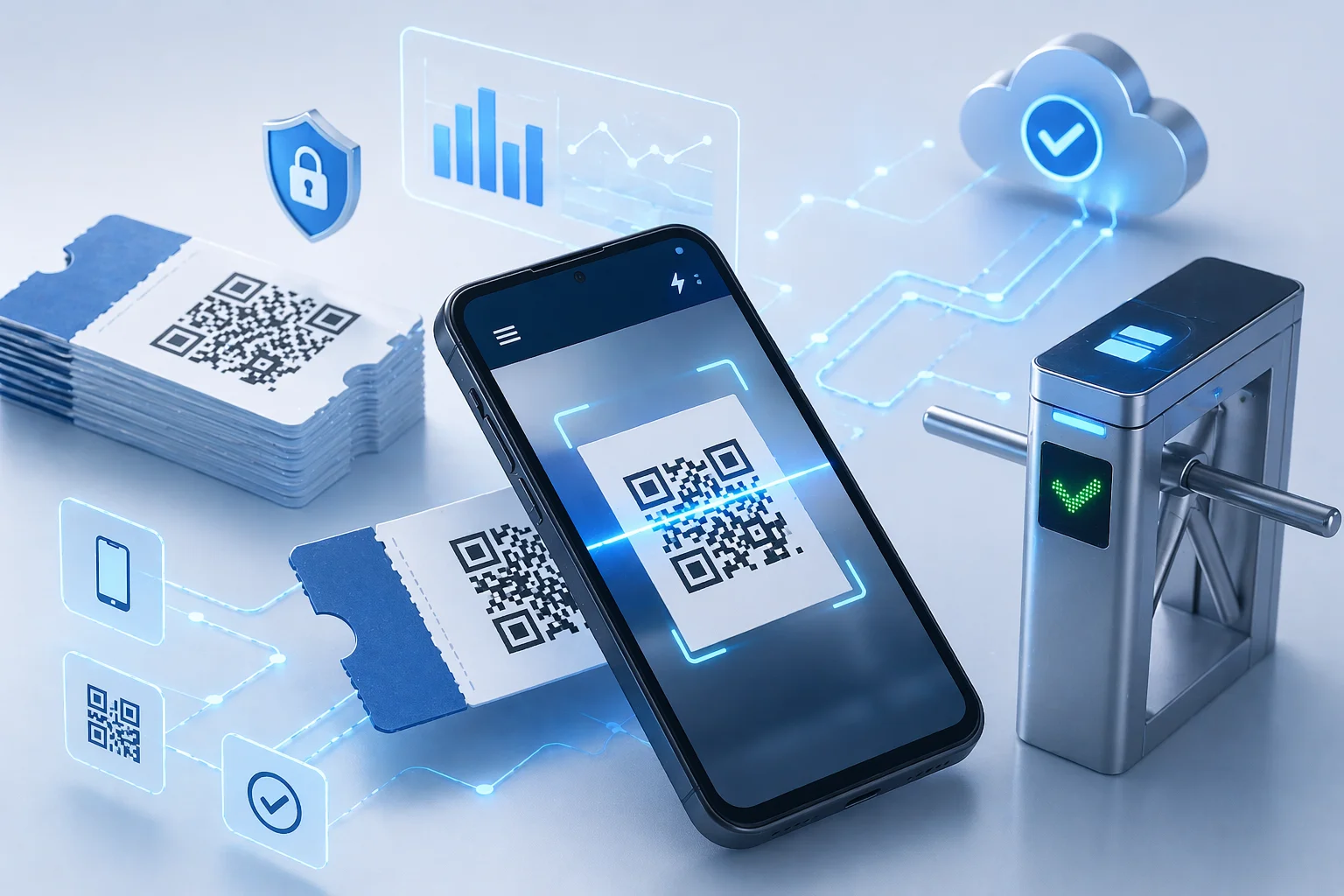

Tickets purchased in online stores are, just like tickets bought at physical points of sale, unique and encoded with a unique code. Tickets sold at physical outlets are printed on highly protected paper and are difficult to counterfeit (well, even money gets counterfeited, but nobody would bother doing that with 10 EUR tickets). It's a different story with print@home tickets, which visitors buy in online stores and print themselves. Such tickets can of course always be copied or reprinted. So what can be done to prevent organizers from suffering losses due to dishonest visitors?
In every conversation about introducing print@home tickets, the same doubt invariably surfaces on the organizer's side: "How do we control tickets that visitors print on their own printers?" In an environment where trust is low and fear of abuse and fraud is omnipresent, it really is hard to give up control and trust in the honesty of ticket buyers. So how can effective oversight of print@home tickets be ensured?
As long as we're talking about a two-digit number of print@home tickets, manual control is feasible. The organizer can simply print a list of print@home tickets on paper and search for each presented ticket on the list, then cross it off. As long as the list is one or two A4 pages long, which is approximately 100 tickets, such monitoring of print@home tickets is simple, convenient, and fast enough. With the given limitations on the number of print@home tickets, this control system is sufficiently effective, and its greatest advantage is, of course, that it's inexpensive. Organizers incur no costs with it, and visitors are naturally delighted because they can enter the venue with print@home tickets.
But what happens when more tickets are sold online than can be monitored with a manual control system? In such cases, a technical device is obviously needed that can simply and quickly scan print@home tickets and electronically verify their validity. When choosing suitable equipment, the specific working conditions at venue entrances must be considered, along with infrastructural, logistical, security, ergonomic, and other aspects. Only through a comprehensive assessment of the challenges does the suitability or unsuitability of each candidate product become clear.
The prices of technical devices that meet the relatively simple usage conditions in non-problematic environments are around 900 EUR. The more demanding the usage conditions, the more powerful and robust the equipment needs to be, and prices quickly reach around 1,650 EUR.
For the circumstances in which Slovenian organizers operate, this is of course a lot of money, although the investment in equipment would pay off relatively quickly. Let's calculate: the income of organizer X, who organizes at least 10 events per year, attracting at least 300 visitors with paid tickets sold at 10 EUR, is 10 events x 300 visitors x 10 EUR, which is 30,000 EUR. At a 5% abuse risk, meaning an average of 15 invalid tickets per event, that amounts to 1,500 EUR in potential lost ticket revenue. For this amount, it is certainly possible to purchase powerful dedicated equipment for electronic ticket validation. This calculation clearly shows that buying equipment pays off, but organizers primarily see the amount they would have to invest, and this discourages them from making the purchase.
So we accepted the challenge and began thinking about how to significantly reduce equipment costs. Beyond the lowest possible price, a number of other parameters naturally had to be considered. A cheap solution cannot satisfactorily resolve the challenge of effective ticket validation until it is so simple to use that any security guard can operate it without problems, and it must also be extremely convenient and sufficiently robust. From a purely formal technical standpoint, a device with the following minimum specifications is needed: it must have a camera capable of reading various types of codes, it must allow sufficiently fast data transfer, and it must permit the installation of a dedicated application that will validate the scanned codes. Most smartphones meet these requirements.
We therefore developed an application that is installed on a smartphone running the Android operating system (version 4.1 or higher) and whose purpose is to use the phone's camera for scanning tickets. Such a solution is not, and cannot be, a complete replacement for professional dedicated equipment, but smartphones are very affordable. You can see how the solution works in a short video, and testing has shown that approximately 15 tickets per minute can be scanned with a phone.
Related stories


Ready for the next step?