November 7, 2016

Vouchers / manual control of print@home tickets / electronic ticket validation

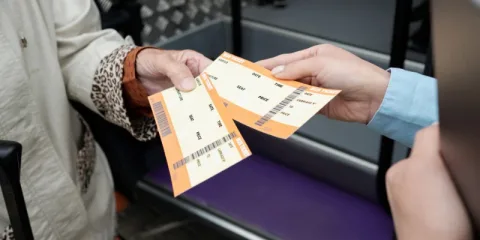
Tickets purchased online are, just like tickets sold at venue box offices, uniquely encoded with a barcode or QR code. Those sold at physical points of sale are printed on highly secure paper and cannot be forged. The situation is different with print@home tickets purchased online. Such tickets can, of course, be copied or reprinted. So what can be done to prevent losses and revenue shortfalls from ticket sales due to the dishonesty of individual buyers?
VOUCHERS The simplest solution is, of course, vouchers. The event visitor presents the voucher at the local box office and exchanges it for tickets. The method is truly straightforward and requires no investment in equipment, which is why it is so widespread. However, it must be said that it is not visitor-friendly. It often happens that exchanging vouchers requires waiting in line, which is not fair to those who made the effort to buy their tickets online.
MANUAL CONTROL OF print@home TICKETS At the close of advance sales, the organiser simply prints out a list of print@home tickets from the system, which serves for manually recording tickets that have already entered the venue. This method works well and is useful as long as the number of print@home tickets is relatively small. What constitutes a small number of tickets is impossible to define in absolute terms. For some, even 50 print@home tickets is unmanageable, while for others, even one or two hundred print@home tickets pose no problem. This method is also simple and requires no investment in equipment, which is why it is popular among event organisers at venues with a capacity of up to 200 visitors.
AUTOMATIC TICKET VALIDATION AND VISITOR ACCESS CONTROL
WITH A SMARTPHONE For electronic ticket scanning, you need an Android smartphone with the dedicated DRAGON ACS Monitor application installed. Tickets are scanned using the phone's camera, which must be connected to the internet. This convenient solution cannot fully replace a professional access control system, but it is useful at smaller venues and, above all, much cheaper than a professional system. You can read more about this solution at (https://mojekarte.com/en/blog/kontrola-vstopa-in-preverjanje-vstopnic-s-pametnim-telefonom), where a short scanning demonstration video is also available.
WITH DEDICATED PROFESSIONAL EQUIPMENT Purchasing or renting professional dedicated equipment for electronic ticket scanning is the only comprehensive solution that completely prevents ticket fraud, and any attempts are doomed to failure in advance. The only drawback of this system is the cost. At least, that is the opinion of organisers. But is that really the case? Let us do the maths.
The price of a professional handheld ticket scanning device is around EUR 1,500. At a ticket price of EUR 10, the purchase value of one dedicated professional device for scanning and validating tickets is equivalent to 150 sold tickets. Let us say someone organises 10 events per year, with an average of 500 visitors at each. On an annual level, that is 5,000 tickets sold, and 150 tickets represent a mere 3% of annual ticket sales. Let us clarify what this actually means. It means three invalid tickets for every 100 visitors! It is probably quite clear that such a small number of tickets is virtually impossible to detect if ticket control is not supported by modern technology. This calculation therefore paints a completely different picture and turns the claim that such a system is very expensive on its head.
It is obvious that the investment in the device pays for itself very quickly, and electronic ticket validation and access control bring added value both for the organiser and for visitors, who can enter the venue directly with their print@home tickets without waiting.
Related stories


Ready for the next step?